Published: April 6, 2026
Present Passive Indicative
Struggling with present passive verbs in Latin? Learn the Present Passive Indicative with simple charts, easy explanations, and examples you will actually remember.
Overview of the Present Passive Indicative in Latin
The present passive indicative describes an action that is happening right now, but importantly the subject is receiving the action instead of doing the action of a sentence.
For example:
- portātur — he/she/it is carried
- videntur — they are seen
- audior — I am heard
As you can see, a passive verb answers: "What is being done to the subject?" and not "What is the subject doing?" like is the case with active verbs.
If you can learn and recognize the verb endings (r, ris, tur, mur, minī, ntur), passive verbs will be much easier to spot in sentences. For example...
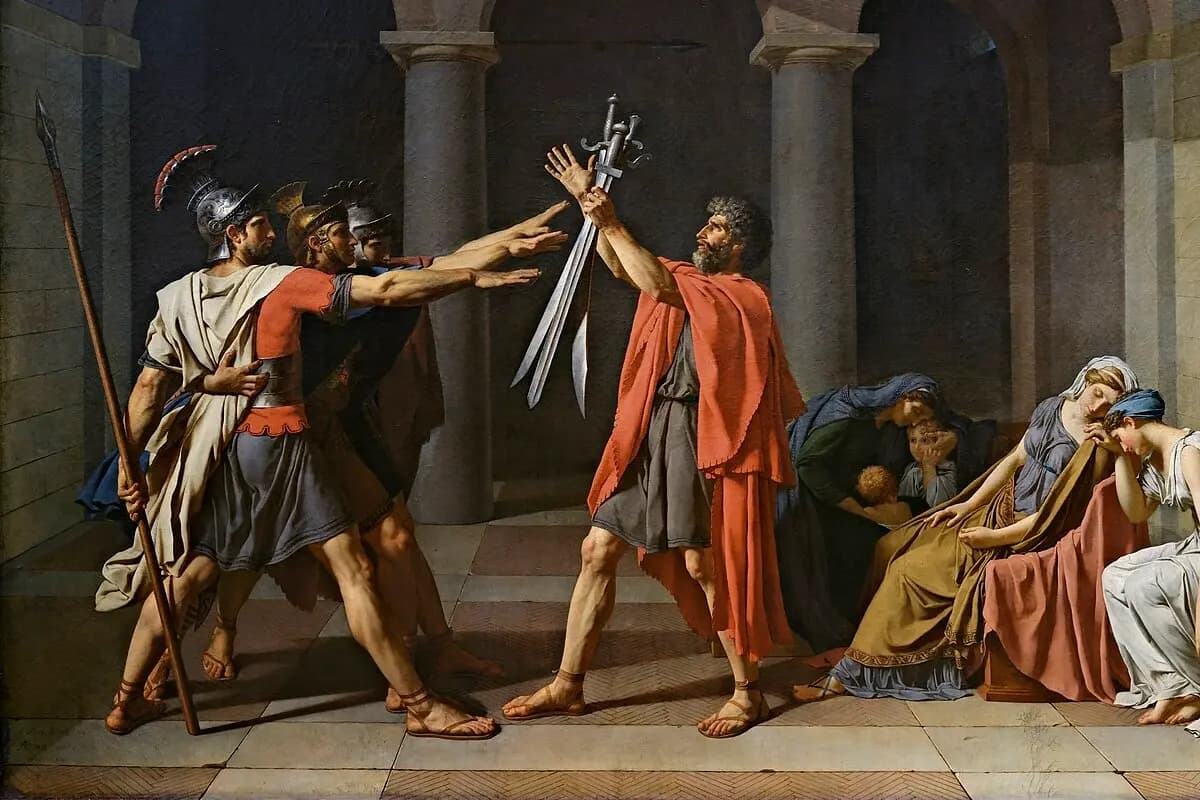
Gladiī ā frātribus accipiuntur.
The swords are received by the brothers.
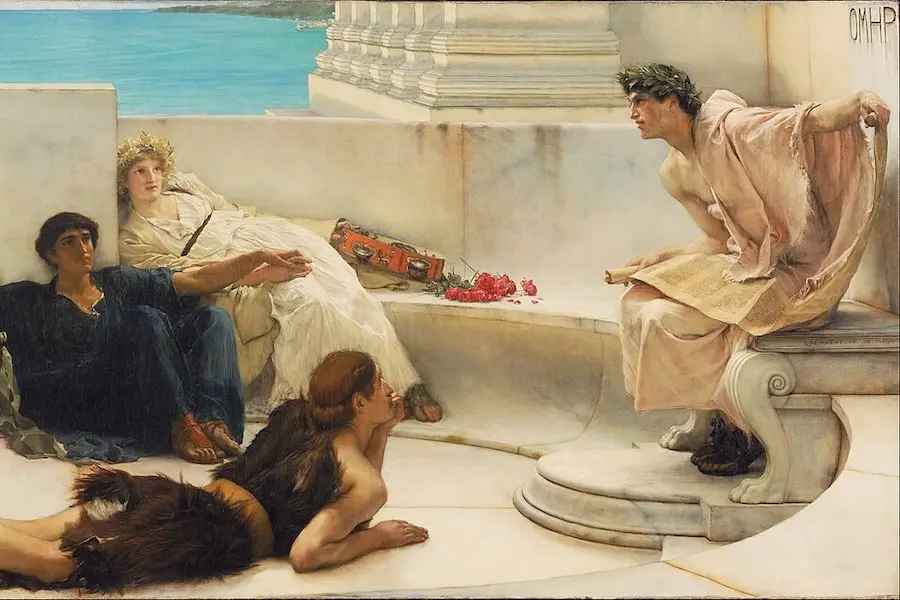
Carmen recitātur.
The poem is recited.
Vesuvius vidētur ā nōbīs.
Vesuvius is seen by us.

The Present Passive Indicative Personal Endings
Instead of the present active endings we are used to (-o, -s, -t, -mus, -tis, -nt), we need to use present passive endings, which are as follows:
| Present Passive Indicative Endings | ||
|---|---|---|
| Singular | Plural | |
| First | -or / -r | -mur |
| Second | -ris | -minī |
| Third | -tur | -ntur |
Here is an example of the endings on the verb voco, vocāre (“to call”).
| voco, vocāre - Present Passive Indicative | ||
|---|---|---|
| Singular | Plural | |
| First | vocor I am called | vocāmur we are called |
| Second | vocāris you are called | vocāminī you (plural) are called |
| Third | vocātur he/she/it is called | vocantur they are called |
You will need to memorize the present passive indicative endings. One of the best ways I have found for students to remember is to sing the endings to the tune of "We Wish You a Merry Christmas" like so…
"-r, -ris, -tur, -mur, -minī, -ntur.
-r, -ris, -tur, -mur, -minī, -ntur.
-r, -ris, -tur, -mur, -minī, -ntur.
passive endings for sure!"
(Although some of my students prefer to end it with "passive endings are murder.")
How to Form the Present Passive Indicative
The present passive indicative is formed from the present stem of the verb combined with a the present passive personal endings. While it mostly follows the same pattern, some forms like the first person singular, second person singular, and third person plural have variations that depend on the conjugation.
Again, the standard passive endings are: -r, -ris, -tur, -mur, -minī, -ntur
To form the present passive:
- Begin with the present infinitive (second principal part).
- Remove -re to obtain the present stem.
- Add the appropriate passive endings, adjusting where necessary for conjugation patterns.
The first person singular always ends in -or, replacing the active -ō. The second person singular typically appears as -ris. The third person plural varies by conjugation and must be learned as part of each conjugation 's pattern: -antur (1st), -entur (2nd),-untur (3rd), and -iuntur (4th).
For example, from vidēre ("to see"), the present stem is vidē-, and the forms are:
- videor — I am seen
- vidēris — you are seen
- vidētur — he/she/it is seen
- vidēmur — we are seen
- vidēminī — you all are seen
- videntur — they are seen
The Present Passive Indicative of the Four Conjugations
Here are some examples of the present passive indicatives in different conjugations.
First Conjugation
| laudō, laudāre - Present Passive Indicative | ||
|---|---|---|
| Singular | Plural | |
| First | laudor I am praised | laudāmur we are praised |
| Second | laudāris you are praised | laudāminī you all are praised |
| Third | laudātur he/she is praised | laudantur they are praised |
Second Conjugation
| videō, vidēre - Present Passive Indicative | ||
|---|---|---|
| Singular | Plural | |
| First | videor I am seen | vidēmur we are seen |
| Second | vidēris you are seen | vidēminī you all are seen |
| Third | vidētur he/she is seen | videntur they are seen |
Third Conjugation
| mittō, mittere - Present Passive Indicative | ||
|---|---|---|
| Singular | Plural | |
| First | mittor I am sent | mittimur we are sent |
| Second | mitteris you are sent | mittiminī you all are sent |
| Third | mittitur he/she is sent | mittuntur they are sent |
Fourth Conjugation
| audiō, audīre - Present Passive Indicative | ||
|---|---|---|
| Singular | Plural | |
| First | audior I am heard | audīmur we are heard |
| Second | audīris you are heard | audīminī you all are heard |
| Third | audītur he/she is heard | audiuntur they are heard |
The Ablative of Agent
When using the present passive indicative in Latin, the person doing the action is expressed with the ablative of agent, which uses ā/ab + the ablative case (e.g., Puella amātur ā amicis eis = "The girl is liked by her friends"). Use ā before consonants and ab before vowels or for clarity.
This construction is only used for people or agents; if a thing is performing the action, Latin instead uses the ablative of means without ā/ab (e.g., Hostis necātur gladiō= "The enemy is killed with a sword").
Here are a few examples of the Ablative of Agent:
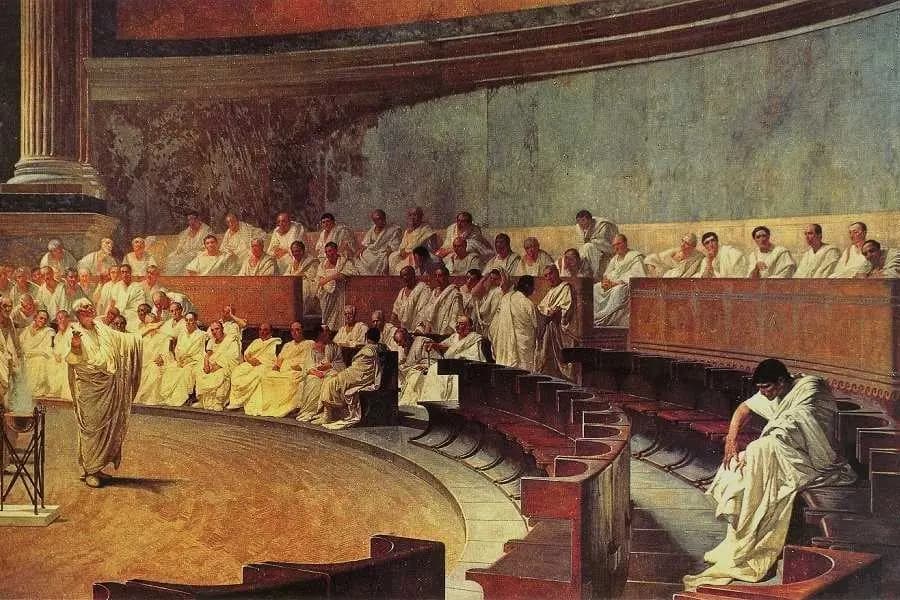
Catilīna ā Cicerōne dēnūntiātur.
Catiline is denounced by Cicero.
Caesar ā Brūtō vulnerātur.
Caesar is stabbed by Brutus.
.7b692322.webp&w=1920&q=75)
Final Thoughts
I hope this article helps make your life a little easier! Let me know if you think of any I could add!
- Patrick
Thanks for reading!
Ideas or Suggestions?
Have an idea for how to improve this article? Let us know!
Click to Email Us
Patrick Mooney
Patrick received his bachelors degree in History and Classics (with an emphasis in Latin) from the University of Mississippi. Afterwards he earned a Masters degree in History from the University of Tennessee where he studied Medieval Latin manuscripts and paleography. Patrick taught 6th - 12th grade Latin for five years at a public charter school in Arizona. In 2022, he switched to a career in web development where he worked primarily on tourism websites across the US. Patrick now splits his time between teaching 7th grade Latin, running a freelance web-development business, and building Arcade Schoolhouse.
